I, the jury

October 28th, 2011 No comments

I just spent the past two days of my life doing jury duty – something that I have never done in my lifetime.

Serving on the jury was actually quite rewarding. You know the good feeling you get after you vote, where you realize you did your duty as a citizen and you think about how awesome our country and system are (even if you are the cynical type who otherwise thinks everything is gone to shit?) I felt that good feeling – I was an important part of making our justice system work, making sure a fair trial happened and justice was done as best as we can. It sounds unremarkable, but for 99% of human history and in much of the word even today, that doesn’t happen, but when things are working, it does here, and you and me are a big reason why.

The jury itself was interesting. We were 12 strangers, but together in a very intimate environment. I joked it was kind of like air travel – you are in a small space with total strangers and you can’t use your cell phone! During the two days we mostly made small talk (the same kind you’d make with folks in an airport) – we were not allowed to discuss the case until deliberations, and once those started we pretty much stuck to business. Everyone was friendly and willing to debate and discuss in an open and respectful manner – there were no “angry men” or serious arguments; it was very collaborative. Demographically, there were more retired folks then I would have expected based on random chance, and the male/female split was 7/5.

The actual mechanics of how the case is run and how the courtroom works is surprisingly casual and almost banal – I wasn’t quite expecting the crisp severity and scintillating drama of Law and Order, but even so, it was interesting how, well, ordinary everyone was. The lawyers for both sides spent a lot of time looking through their papers between questions, and everyone was polite and laid back. There were no dramatic objections (in fact, objections were discussed between counsels in whispers in front of the bench, all the better to prevent the jury from hearing anything we shouldn’t), the witness examinations and crosses were very mellow, and even in the closing remarks there wasn’t much Sam Watterson channeling Clarence Darrow. The judge kept things moving, but in the relaxed way of an experienced teacher interacting with students while moving things along in a classroom.

The judge made it very clear that we were only permitted to consider the evidence presented in the courtroom as jurors. We were not to talk about the case with anyone outside the jury, and we were not allowed to do any independent research (including electronic) while the case was underway. Specific mention was made of 21st century distractions like Facebook, Twitter and blogs (the judge even joked that we couldn’t tell anyone on MySpace, but that nobody used MySpace anymore!). She also noted that phones needed to be off while in the courtroom. Mentally, I kind of thought of this like some kind of “cone of ignorance” – everything we needed to know would be in court, it was the job of the two sides to give us what we needed to make our decision – we are not detectives. I understood all of this intellectually, but it was still a big responsibility – this was someone’s life that would change based on what we decided.

So, the actual case (and now that the trial is over, this is all public record and we are permitted to discuss it and anything about the deliberations).

Essentially, the defendant (technically called the respondent because he was under 18 when the crime occurred) cut off another guy in traffic while making a turn onto South Iowa Street from 23rd. The guy who was cut off made his displeasure known, via the usual yelling and bird-flipping, and the guy who cut him off responded in kind. The victim tailgated the first guy on down Iowa Street, and they got into it, just like two guys with more testosterone then common sense are wont to do. So, two guys acting like jerks. However, it got very serious when the first guy (the one who originally did the cutting off) brandished a gun – basically held it up to let the other guy know he had it (without actually pointing it at him). At that point, the second guy (the victim) fell back and called 911, while continuing to follow the first guy at a greater distance. They continued down into rural Douglas County, and the sheriffs eventually pulled over the assailant.

There were two charges, making a criminal threat (and I am paraphrasing, I don’t recall the exact title of that charge), and aggravated assault.

We had the following pieces of physical evidence made available to us (“published to the jury” in the parlance of the court)

  • The tape of the 911 call
  • A map upon which both the defendant and victim marked where events occurred.
  • The gun itself (which was a realistic-looking BB gun)
  • A videotape of the police interview with the defendant
  • A videotape of the police interview with the defendant’s sister, who was in the car with him.
  • The written statements of the victim, the defendant, and the defendant’s sister.

    The state called the following witnesses:

  • The victim
  • The defendant’s sister – as a subpoenaed witness (she didn’t want to testify against her brother)
  • Three police officers; the sheriff who made the initial stop and the two officers who did the interviews

    The defense only called one witness, the defendant himself (he didn’t have to testify, but chose to).

    The general outline of what occurred wasn’t really questioned by either side, but there were some inconsistencies in the various details that made it less then an open-and-shut case.

    I am not going to give a play-by-play of the trial or deliberations, but the things we paid attention to and ended up being important included issues like:

  • How was the gun actually held and displayed
  • Did the victim have “reasonable” fear of “imminent bodily harm”
  • Was there any claim to self-defense by the defendant
  • What was the relative position of the two vehicles during the back and forth down Iowa Street, and what could be seen from where?
  • Did the defendant flash the gun the get the victim to ‘back off’ from the continuing tailgating/road rage or did he mean to actually attack with it.

    We also looked at the written statements that the parties provided to the police. It ended up that of all the people, the defendant’s sister seemed to be the most reliable witness.

    After the closing arguments, we deliberated for about four hours. The bailiff made our lives as jurors easier by baking us brownies (yes!) and bringing in lunch from Free State while we deliberated.

    We found the defendant guilty of the lesser charge of making a criminal threat, but not guilty of the assault charge – primarily because assault required the the threat of imminent bodily harm, which we felt was not proved.

    I am glad that I had this experience. It was just two days of my life, during a relatively slow time at work. If it had been two weeks during a crunch time, I might not be as sanguine, but regardless, I felt honored to do my part as a citizen, and proud that I did my service diligently and responsibly. There’s not much that our society or our government really asks of citizens any more. We don’t have t vote, we don’t have to join the army, and don’t get me started on taxes – but serving on a jury really helps the system work – and it did work. This was real life; although the crime was relatively minor, it affected peoples’ lives on both sides, and involved everyone from the 911 dispatcher who answered the call to the cops who did their job investigating and the district attorneys, the judges, their clerks and assistants, and even the defense attorney who did her job representing her client as best she could, making the state prove its case. Everyone did their jobs. All you have to do is look around the world and look in history books to see that although we take this for granted, how rare this is in human history.

    Fundamentally, the jury fundamentally helps our legal system work in a fair way, is a check on the power of the state, helps see justice done, and I was happy to have been able to do my part.

    And, for Google’s sake, here’s some information about serving on a jury in Douglas County Kansas that isn’t covered by the county’s FAQ

    1. Yes, you can bring a book or crossword puzzle or whatnot to do while you wait. Don’t count on using your phone for entertainment or to pass the time; frequently it must be off, but you can always read a book during breaks or while waiting (although obviously not while in the courtroom).

    2. Casual dress is fine. By that, I mean even a nice pair of jeans and a collared shirt. You don’t need a suit or even Dockers (although nothing’s stopping you from looking nice!) Nothing torn or ripped, no shorts, and no T-shirts or shirts with writing on them.

    3. Cell coverage in the judicial center sucks. AT&T simply didn’t work at all anywhere inside the building. So even when you can use your phone, don’t count on it working. However, there is a Knology hot spot in the building, so during breaks when you are allowed to use your phone, you can get online this way.

    4. Our judge was pretty savvy and actually mentioned this during her instructions, but to be clear, you just can’t talk about the case or search for information about it on the internet during the trial. For those (like me) addicted to social media, that means no Tweeting or Facebook or anything. This seems obvious, but a lot of us are so used to casually mentioning things that it would be easy to slip up if you didn’t make a specific effort not to. You are allowed to say you’ve been called for jury duty, but that’s it – you can’t mention what trial you are involved in or any details. I checked in to the Judicial Center on Foursquare but never became the Mayor (Chief Justice?)

    5. The court day ends around five PM – it won’t go any later; and it starts whenever the judge says, anywhere from between 9 and 10. There are relatively frequent recesses, so you’ll have a chance to stretch and get water. On the day we deliberated, they brought us lunch, but on the trial day, we got an hour and a half to get lunch on our own. They give you temporary employee badges so you can get in and out of the building without going through the metal detector in the front.

  • Categories: Life Tags:

    WWDC Wayback Machine: 1999

    June 14th, 2011 8 comments

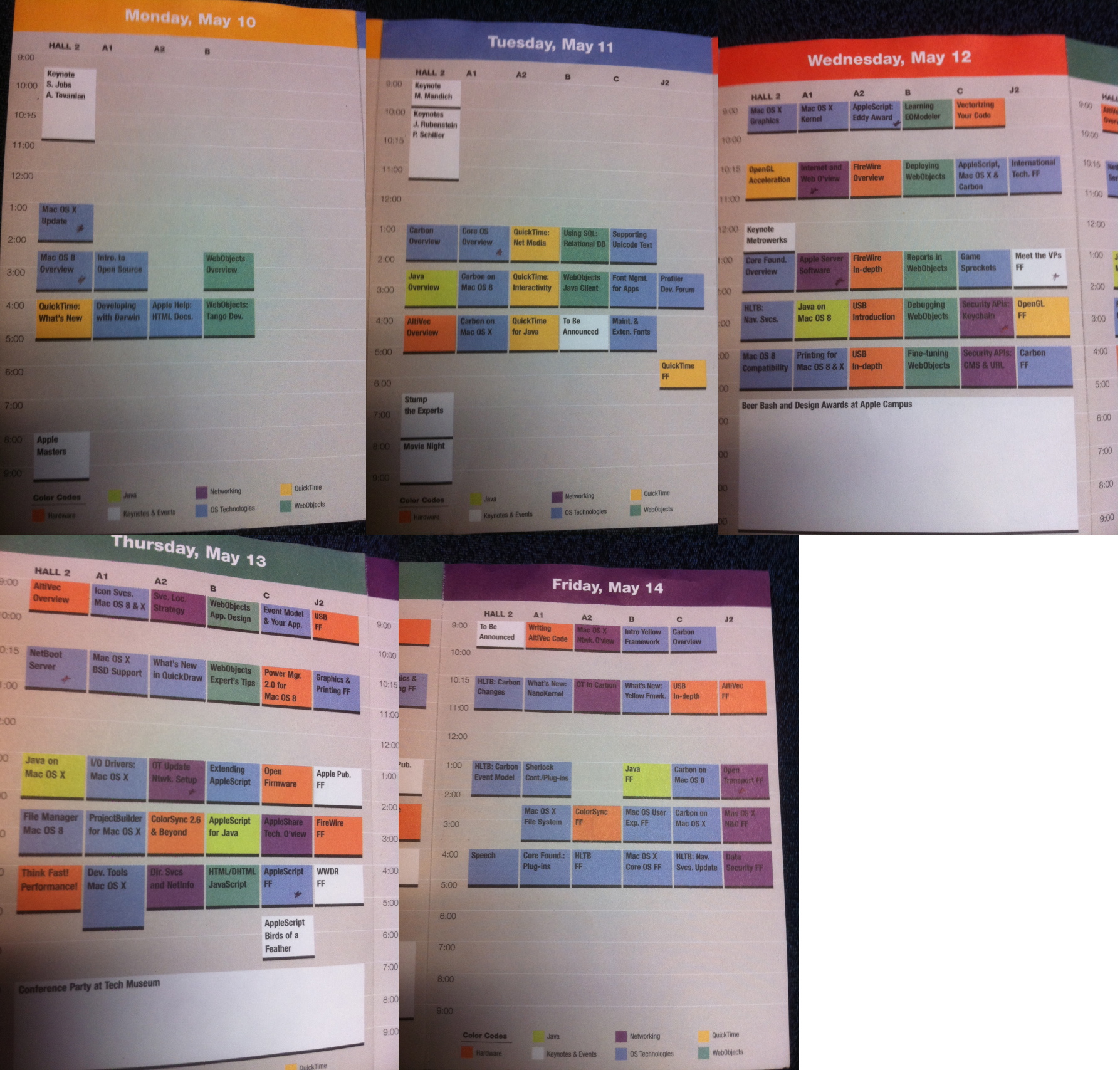
    The WWDC 1999 Schedule. Click to embiggen

    Ah 1999. President Clinton, fresh from his brave conquest of Monica Lewinsky and the Serbian Air Force proudly led a nation in the grip of economic boom and millennial fever. Grateful citizens dialed in to their ISP and fired up their Netscape browsers to search Lycos for the latest and greatest. No iPod. No OS X. No iPhone. No iOS. No Youtube. No Twitter. No Facebook. No Hulu. Honestly, what in the hell did we do? I think we USENETed our Prodigy or something, but I can’t remember because I haven’t taken my pills today.

    Apple was just coming out of their mid-decade tailspin, and new Interim CEO Steve Jobs was presiding over a company on the rebound. The iMac was fresh, colorful and awesome, and the stock was rocketing into the 20s. And yes, there was WWDC so developers could learn about new technologies. MacOS 8.5 was coming, and MacOS X was the future. WWDC itself was held in the San Jose convention center. It was smaller, less then a fifth the size of today.

    Home from the recently concluded 2011 version of WWDC, I found one of the original 1999 WWDC schedules in my office, and used the poor man’s scanner (i.e. the iPhone camera) to reproduce it for your pleasure. It is a fascinating trip down memory lane of both old technologies, and how WWDC used to be structured. The Stevenote still kicked things off, but Steve shared the bill with Avie Tevanian. The evenings has a lot more ‘official’ activity then today, with events like Apple Masters, Movie Night, and a conference party that was separate from the Beer Bash. The technologies? Some you’ve probably heard of (Java, Carbon, Cocoa), and some have faded down the memory hole (Game Sprockets, anyone?). WebObjects was in big, with numerous sessions, and there is a big focus on Java as well. There’s also numerous IO hardware-specific session on topics like USB and Firewire. There were also tons of Feedback Forums for the various technologies and teams at Apple.

    Anyway, click the photo above to see the full-size version, and party like it’s 1999.

    Categories: Apple Tags:

    My favorite end-of-the-world books

    May 20th, 2011 2 comments

    As we all know, the world is coming to an end tomorrow (and if you’re reading this after May 21, then you obviously weren’t good enough to make the Rapture), so why not kick back and spend the last few hours on the earth reading a good post-apocalyptic disaster novel? I’m a fan of the genre, and these are a few of my favorites, organizaed by the means to mankind’s demise….

    Water
    Flood and Ark by Stephen Baxter.

    Water wells up from below the oceans, inundating the world.


    Plague
    The Stand by Stephen King

    Bio-engineered flu wips out humanity.


    Nanotechnology
    Blood Music by Greg Bear

    The original “grey goo” novel.


    Earthquake
    The Rift by Walter Williams

    The Big One hits – at the New Madrid fault, tearing America in two.


    Meteor
    Lucifer’s Hammer by Larry Niven and Jerry Purnelle

    Big meteor. Bigger bang.


    Nuclear War
    The Last Ship

    There are tons of great post-nuke books, but this unique one, from the perspective of a Navy ship at sea, is an underrated gem.


    Aliens
    Out of the Dark by David Weber

    A nice solid, fun alien invasion set in the Internet era.


    Zombies
    World War Z by Max Brooks

    Hungry zombies. Lots of guns.


    Peak Oil
    World Made by Hand by James Kunstler

    Life in small town after a sudden decline in the world’s oil


    Economic Collapse
    Soft Apocalypse by Will McIntosh

    There’s nothing Great about this Depression, but the book is stunning.


    Magic
    Dies the Fire by S. M. Stirling

    The laws of physics change with devastating consequences to civilization


    Infertility
    Children of Men by P. D. James

    No more babies.


    Evolution
    Evolution by Stephen Baxter

    Life evolves. Humans do not (at least not anything like what we would expect). And yeah, Baxter’s on here twice. He’s that good.


    Supernova
    Aftermath by Charles Sheffield

    When a nearby star goes supernova, things do not look good for little old Earth

    Categories: Books Tags:

    AT&T: Our masochistic customers want to be capped

    May 5th, 2011 No comments

    So, as most people know, AT&T has started capping their broadband internet packages. This is a thoroughly awful, consumer-unfriendly act, but, with a bit of doublespeak that would make a Soviet commissar blush, AT&T is claiming that customers actually asked for caps! Needless to say, I had to find out more, and, well, it sure looks that way according to this official AT&T press release:

    Joyful Proletariat Welcome New AT&T Internet Enhancements

    Peasants Cheer as Precious Bandwidth Allowance Distributed

    May 2, 2011 – As Reported by Official News Service of DPRK-AT&T

    As reported by the glorious Peoples Commissariat of Internet Resources (known to the decadent bourgeoisie as the AT&T Marketing Department) workers and peasants through the Peoples Republic of AT&T expressed their unalloyed joy at the latest culmination of the the glorious Five Year Bandwidth Allocation Initiative, which grants all members of the Outer Party an amazing 150 GB of precious bandwidth every month. The People's Congress has also agreed to award Inner Party members up to 250 GB of bandwidth, as a reward for loyal service to the Motherland.

    Bandwidth is a precious and limited resource of the State, and AT&T citizens are grateful and thankful that this precious resource is now limited. Prior to the new limits, wreckers and bourgeoisie infiltrators used more then their fair share of this resource.

    Winston Smith, a proud Party member in our great Workers Paradise, was quoted as saying "Previously, I lived in fear that I was inadvertently weakening our State by using too much bandwidth. I am so relieved that the I may now use only 250 GB of data. The strong, comforting hand of our Great Leader acts as a rudder upon the ship of my broadband connection!"

    It is expected that any workers who are not satisfied with their bandwidth allocation will engage in public Self Criticism at the next Party committee meeting.


    Categories: Uncategorized Tags:

    A soft apocalypse is a hard read

    May 5th, 2011 No comments

    Will McIntosh’s “Soft Apocalypse” is one of the most emotionally intense and harrowing books I have read in several years. Set in the near future, it is the story of one man, and his friends, as they live through the terminal decline of our modern civilization.

    “Soft Apocalypse” is refreshingly different then most “end of the world” genre books – you see, this book is about you. Yes, you. You are no action hero. You don’t know how to grow your own food, and you probably aren’t a crack shot. If you were in a zombie movie, your brains would be in the digestive tract of the walking dead. This book’s author’s protagonists are all ordinary people like you and I, not action heroes.

    Throughout the entire book, the protagonist, Jasper, deals with life as society slowly crumbles. He doesn’t have any grand plan, he just muddles by, unheroically, with a circle or friends, as things gradually decay. The book takes place over a decade, and through the slings and arrows of Jasper’s daily life, you get a real sense of what it is like to live through the gradual decay of civilization. If most fictional ends of the world are the sharp bite of a cobra, this one is the slow, long suffocation of a constrictor.

    Our story opens with Jaspar and friends living as travelling nomads a few years after a major depression has led to 40% unemployment. While things are bad, modern life is still holding up. The power’s on, you can still find Oreos at the grocery store, and a text message is still the fastest way to stay in touch with friends. Yet, the middle class has declined, the armies of the poor are vast, and the rich live in secure privately-guarded enclaves while ostensible public servants such as the police do nothing to prevent or try to stop crime. In many ways, it is America as a third world country.

    As the years pass, Jasper settles into a modicum of stability as a convenience store manager, moving in and out of various social circles consisting of old and new friends, as the world around him continues to crumble. The economy just doesn’t improve. A nihilistic tribal-ish terrorist movement called the Jumpy Jumps spreads random dadaesque violence. Strange new diseases and genetically engineered destruction accelerate the decay of both the natural and man-made environment.

    There are so many fascinating and well-written vignettes here – a bowling alley during a power outage, a trip to a virtual reality speed dating service, a flash rock concert, an abandoned carnival, canine-powered taxis, browsing an abandoned bookstore, and even (a bit too sterotypical) an emergency surgery via cell phonel.

    This is a challengingly violent book – brutal rapes, torture, violence against people and animals – that are frankly disturbing and in many ways reminiscent of accounts I have read from World War II. In one scene, paramilitaries are executing citizens, and Jasper spots a fondly-remembered teacher about to be shot, and all he can do is look away while the man begs for help. Even a riot which destroys a Wal-Mart is rendered in a way that is less about economic despair and more about pure nihilism. Many of the scenes of destruction are more heart-rending then other books’ nuclear wars, perhaps because those are massive, while this book is, in many ways, very intimate. As ugly as the violence is, it is never gratuitous or celebrated, and is presented as a necessary part of the plot.

    There is despair in “Soft Apocalypse” – the book in many ways seems the fictional representation of the famous poem by Yeats – the center definitely cannot hold, and a bevy of antagonists tear down society while decent people – including our protagonist, can’t do much other then survive the best they can as the rudiments of civilizations gradually seep away. The book’s strength is the author’s exposition of Jasper’s essential humanity, even after he sees everything he has cared about fall away and is forced, in the end, into making a terrible choice. Like Cormac McCarthy’s The Road , there is no happy ending, but like “The Road” the “Soft Apocalypse” is at its best when exploring the human condition, and how humanity can exist even in the most terrible conditions.

    “Soft Apocalypse” is not a fun read, but is a very good book, and has provoked hours of thought and reflection, even after I was finished. It also kept me up at night, and it has been a while since any book was able to do that.

    Categories: Books, reviews Tags:

    Top 10 cocktail party non-sequiturs

    January 14th, 2011 3 comments

    If you really need to end a conversation in a hurry, wait until the other party has made what they consider to be a witty or important point, and then say one of the following:

    (in random order…I don’t know which one is the funniest. I don’t know if any of them are funny!)

    10. “That’s fascinating, but I don’t think the Bishop would have seen things that way.”

    9. “What did you do with the marmot when you were finished?”

    8. “It’s amazing how the artist deconstructed the entire paradigm ontologically through the medium of inverse interpretive dance”

    7. “I don’t care what your favorite data pattern is, I still like the smell of fresh-baked chocolate-chip cookies!”

    6. “Colorless green ideas actually don’t sleep furiously. I know for a fact they have insomnia.”

    5. “How can you say something like that in presence of Her Majesty the Queen?!”

    4. “God is actually shaped like a slightly lopsided rhombus.”

    3. “I am working on a theory as to how the pigs procreate, being that they are green circles lacking in both legs and external reproductive organs”

    2. “The gleam in your eye definitely strikes me as that of a time traveller. Your secret’s safe with me, but tell me, how do you like things here in the 18th century?”

    1. “Sixteen badgers along with four raccoons, eh? And only three pounds of kidney beans, you say? Wow, you are amazing!”

    Thanks! I’ll be here all week, don’t forget to tip your hostess.

    Categories: humor Tags:

    Review: Across the Universe

    January 9th, 2011 No comments

    Across the Universe by Beth Revis

    “Across the Universe” is an excellent, fairly fresh take on the generational starship theme written for teenage/young adult readers. The basic themes are familiar – a passenger in hibernation is unexpected woken up, the cloistered society of the ship has gotten really weird over hundreds of years, and a tyrannical leader rules with an iron fist (and some help from genetic engineering and drugs). However, the author deftly blends these themes together, creating believable, sympathetic characters living in an environment that is weird enough that you wonder how things really work. The story itself is fairly straightforward, told from the alternating perspectives of the two protagonists – the teenage girl unexpectedly awoken, and the son of the ship’s absolute leader.

    As both protagonists discover more and more about the truth of the situation on the ship, they are faced with a bit of a murder mystery as well as threats from both the ship’s dictator, Eldest, and the various forces that are keeping most of the people living on the ship in a state of almost animal-like somnolence. For those who like the science in their sci-fi, the author is quite believable, creating a realistic shipwide ecosystem, as well as not forgetting small touches, like the fact that the accents of the people living aboard would have gradually changed over hundreds of years to be difficult for a newly-awaked person to understand.

    This isn’t merely lightweight teenage reading. The author imbues even the dictator Eldest with humanity and you can really appreciate the reasons he made the choices he did, even if in the end you will probably not agree with them. No one-dimensional villains here. There’s a small amount of PG-rated romance between the protagonists, but also a few scenes of slightly less mild sexual and physical violence, but nothing outside of the scope of similar books. “Across the Universe” will appeal to both fans of dystopian young-adult literature (readers of the Hunger Games trilogy and the Uglies will likely enjoy “Across the Universe”) as well as anyone who enjoys science fiction or dystopian novels.

    Categories: Books, reviews Tags:

    2010 mostly sucked, but not entirely

    December 30th, 2010 No comments

    The end of the year always brings some reminiscing about the good and bad, and 2010 is no different. Overall the year seemed pretty mediocre, but a couple things really stood out as being positive for me.

    In 2010, the virtual became real, and I actually made real social engagements via the various social media services, especially Twitter. Thanks to this new “town square” I have a lot more casual friends then I have had in the past, and have made real-world friends through the various tweet-ups, get-togethers and other random events, both organized and disorganized. Of particular note, are a few close real-world friends that initially developed purely via Twitter, such as Matt and Megen here in town, as well as numerous out of town folks like Ryan, Ben, Justin, AJ and several other neat people who I never would have gotten to know at all but for a “silly” microblogging service named after the sound birds make.

    I usually follow politics the same way a casual sports fan follow his or her teams – occasional moments of rapt attention and cheering/booing followed by long periods where you don’t pay any attention. In a year when the forces of intolerance were definitely on the rise, the unexpected and dramatic victory for Don’t Ask Don’t Tell repeal was one of the most gratifying and exciting political events I can remember, especially given that it came through the sausage-making apparatus of Congress rather then the drama of a legal decision or an election. For a couple weeks in December, I paid attention to the minute-by-minute minutiae of the Senate, and followed the ups and downs, and in the end, against all odds, the good guys won, the forces of evil were routed, and a major step forward for goodness in America actually happened. That was really awesome.

    And on to miscellaneous ‘bests’ and ‘worsts’ of the past year…

    Favorite game of 2010: A three-way battle between Angry Birds, Worlds with Friends, and Plants vs Zombies. I have to go with the latter; that game was truly amazing fun, although I am frustrated that unlike Angry Birds, the Plants vs Zombie folks have disappeared from the planet with nary an update or sequel in sight.

    Favorite album of 2010: Weezer’s “Hurley” is simple, loud, catchy, and fun. Don’t need anything more complex.

    Favorite movie of 2010: After the greatness of 2009, 2010 kinda stank. Nothing really stood out. Plenty of OK movies, but nothing remarkable. So, no favorite movie. But there were some decent movies, “True Grit” being the most recent one that comes to mind.

    Biggest entertainment disappointment of 2010: The “Lost” finale. Ugh. Talk about finishing with a whimper. But hey, it was slightly better then the Battlestar finale.

    Best comeback of 2010:Futurama” – good news everyone, the show is as good as it was before, which is to say one of the funniest things on TV.

    Crappiest sports moment of 2010: Northern Iowa. Seriously. Ugh.

    Best sports moment of 2010: It’s a tie, between the first KU-KSU game where Sherron Collins single-handedly won the game for KU in the final minute, and the first quarter of the Nebraska-Missouri football game, where Nebraska went up 24-0 on Mizzou. I saw that in a sports bar filled with Missouri fans, which was quite enjoyable!

    Best election result: Lawrence voters passed the library bond. How about that, a vote in favor of both literacy and progress.

    Worst election result: Everything else.

    2010 in one sentence: “Don’t touch my junk!”

    Categories: meta Tags:

    Coffeehouses of Lawrence

    December 27th, 2010 1 comment

    I drink a lot of coffee. Luckily, Lawrence has a lot of places to get coffee.
    Here’s a brief overview of what Larryville has to offer coffee-wise. By the way, all the coffee places in Lawrence as far as I know have free WiFi.
    This list is very subjective, and only includes places that are primarily coffeeshops where there is sit-down seating (so, no tea places and no Scooters). Also not grocery stores with coffee nooks, I want to keep this list manageable.

    23rd Street Corridor

    Z’s East
    Vibe: Townies and commuters, pretty laid back back definitely businesslike
    My thoughts: Great coffee (the house blend is superb, and they have really good mochas), good place to hit coming to or going from Johnson County. I don’t visit this location too often though.
    Bonus features: drive-through, roast their own beans

    Dunn Bros.
    Vibe: Mix of townies and students, study and discussion groups, pretty open
    My thoughts: Decent coffee (and a bonus for two shots standard in 12 oz espresso drinks), lots of good chairs and a fireplace, a good overall chain coffeehouse especially for its location. I go here maybe once a week.
    Bonus features: peanut butter for spreading on bagels!

    Downtown

    Z’s Downtown
    Vibe: Grad students, professors, and townies, pretty businesslike, working and studying.
    My thoughts: Good coffee (like the East location, the house blend is superb, and they have really good mochas), both brewed and mixed drinks, and great location, but seating is limited to tables. Still come here probably once a week.
    Bonus features: roast their own beans

    Starbucks
    Vibe: Thorough mix of Lawrence civilization. It’s a Starbucks.
    My thoughts: It’s a Starbucks. You know what you’re getting. Not very much seating, so the place will fill up quickly.
    Bonus features: It’s a Starbucks

    Aimee’s
    Vibe: Very laid back, students reading and studying.
    My thoughts: Haven’t been here in a while, but good location on the south side of Downtown, and features lots of comfortable seating and food to go along with the coffee
    Bonus features: Couches and antiques

    Henry’s
    Vibe: Mostly townies, some students, intellectual
    My thoughts: Only table seating, but really good coffee and nice decor. The baristas are probably the most artistic in Lawrence with drawing cute designs on the mochas. Bonus for the awesome little bar upstairs. Downside is in the summer they have a persistant problem with flies. Probably come here a couple times a month.
    Bonus features: upstairs bar, late hours

    Bourgeoisie Pig
    Vibe: More townies then students, casual and laid back, strong group of regulars
    My thoughts: I’ve only been here a couple times, so I can’t really testify to the quality. However, the Pig is very popular and has a loyal group of regulars. They also have a liquor license and for smokers, have the most comfortable smoking porch among Lawrence coffeeshops.
    Bonus features: booze, covered smoking area, late hours

    Java Break
    Vibe: Townies AM, students PM, very laid back, place to read, study and hang out
    My thoughts: One of my favorite places in Lawrence, really good speciality and espresso drinks, several rooms with different feels, great location, and offer cereal and food in addition to coffee. I come here several times a week. Probably the best mochas in Lawrence, but annoyingly, they don’t offer a 12 oz size for any drink.
    Bonus features: sandwiches and cereal, couches, open 24 hours

    Signs of Life
    Vibe: Artsy, mostly students, Christian
    My thoughts: Good coffee and a nice relaxed intellectual vibe. Good place to work for a while. They are closed Sunday for religious reasons. They have good mixed drinks, especially like the “donkey”
    Bonus features: Bookstore and art gallery

    Prima Tazza
    Vibe: Mixed crowd, intellectual
    My thoughts: I don’t go here enough. I like their coffee a lot (especially the espresso-based drinks), but it is a very small location and there often isn’t any room to sit. Good people-watching.
    Bonus features: Next door to Free State

    Seattle’s Best (at Borders)
    Vibe: It’s a Borders, so lots of “library” patrons and people studying
    My thoughts: It’s a Borders. So, always something to read. I don’t usually go there (for coffee) because I feel awkward taking my own reading material into a bookstore.
    Bonus features: Bookstore

    West Lawrence

    Scone Lady’s
    Vibe: Very quiet, townies and grad students
    My thoughts: A nice quiet place to escape to in the middle of the day to read or get out of the office. Good selection of baked goods. Never seen them crowded. Their Caramel Twist, coffee mixed with caramel (but no milk) is quite good.
    Bonus features: roast their own beans

    J&S
    Vibe: Townies, business people, a place to get work done
    My thoughts: Really good brewed coffee, and a great location, the only coffee shop on the far west area of town. I will usually go here at least once a week, a great “coffee break” from the office. The Mayan Mocha is great, a mocha with chili and cinnamon, the drip coffee is also really fresh and really good.
    Bonus features: roast their own beans, kids play area

    Categories: Food, Lawrence, reviews Tags:

    21 for 2010: The best books I read during 2010

    December 25th, 2010 No comments

    As most of my friends know, I read a lot. I make no claims to read books on every subject – I am quite prejudiced. I only read books that looks interesting to me! Being a geek, I tend towards history, science, and books on “big themes” (and for some odd reason this year, several books set on generational starships). However, part of the pleasure of browsing a real bookstore is that sometimes something completely unexpected will pass my eye, and I will discovered and enjoy a book that I never would have known about otherwise.

    Below is my list of the best 21 books I read through the past year. Not all of these were actually published in 2010 (although many of them were). Why 21? Basically, I went through my catalog of books (yes, I catalog my books – I told you I was a geek!) in reverse order back to the beginning of the year, and this is what I found…

    Pump Six and Other Stories by Paolo Bacigalupi
    A great collection of thoughtful and humane science fiction short stories by the author of “The Windup Girl” (see below). The best among the bunch is the title piece, “Pump SIx” about a a guy who tries to keep civilization going as everything is breaking down and coming apart.

    Death By Black Hole and Other Cosmic Quandaries by Neil deGrasse Tyson
    Tyson’s collection of short essays covers the gamut of astronomy and physics, in a fun and enlightening style. This is one of the rare science books that would be enjoyed by any intelligent person even if they do not otherwise have much interest in science.

    Some We Love, Some We Hate, Some We Eat: Why It’s So Hard to Think Straight About Animals by Hal Herzon
    A fascinating overview of the psychological and cultural aspects of humankind’s interaction with the animal kingdom. If you’ve ever wondered why we keep dogs as pets but eat pigs, or how owners of fighting animals can claim with a straight face that they love the animals they condemn to death, this book will enlighten and entertain you.

    Hull Zero Three by Greg Bear
    A man wakes up in an enormous, frigid, ancient, mechanically unsound spaceship, and has no idea what is going on, all the while being chased by strage horrifying creatures while trying to survive and figure out what is going on. Bear takes the reader on an intense and entertaining journey that plays out like a more intellectual version of the (underrated) movie “Pandorum”

    At Home by Bill Bryson
    Bryson is genius at taking the mundane and peeling it like an onion, and in “At Home” he used the rooms of an average home to explore the social and cultural history of everything from why salt and pepper are our ‘default’ spices to how the modern bathroom came about. As is Bryson’s wont, he peppers his prose with a myriad of fascinating historic tidbits and stories about obscure and not-so-obscure people and their amazing lives. You will never look at your house the same way after reading this.

    On the Grid by Scott Huler
    Infrastructure is the sinew of our society. Without plumbing, sewers, electricity, roads, and communications, we would be living like monkeys. If you’ve ever wondered about how all these systems actually work and what it takes to maintain them, you will enjoy Huler’s book. In the best “Dirty Jobs” style, Huler goes on location investigating (and working with) the people who make our civilization operate by delivering water and power and removing waste. Entertaining and enlightening.

    War by Sebastian Junger
    “War” has won numerous awards, and for good reason. This is probably as close as the average reader can come to getting a feel for the emotional and physical experience of being in combat in a modern wartime environment. The author ‘embedded’ with troops in an isolated firebase in Afghanistan, going into combat with soldiers, coming under fire, and basically experiencing everything except actually firing a weapon. A truly intense and harrowing read.

    Packing for Mars by Mary Roach
    Rocket engines, trajectories, and such are quite important in space travel, but what about how you go to the bathroom in space? Or eat, sleep, and of course, make love? And of course, what happens to the human body when you are weightless for months? The practical issues of “human engineering” are the topic of Roach’s book, and she takes the reader on an enlightening and entertaining trip into the lesser-covered aspects of day-to-day life in space.

    Sex At Dawn by Christopher Ryan and Cacilda Jetha
    Everyone “knows” that men naturally evolved to mate with as many women as possible, and that women evolved to be naturally picky about mating, the best to protect their precious eggs and look for a mate with the right qualities. It’s just common sense. Not so fast! The authors show, carefully, with ample evidence that many of our most cherished myths about what is “natural” human sexuality isn’t backed up by the latest research. Written in an engaging and friendly tone, never lecturing, the authors cover the latest research on human sexuality with wit and verve.

    Lucy by Laurence Gonzales
    Lucy is a “humanzee” – a hybrid of bonobo and human, who is adopted and raised by a woman in Chicago after Lucy’s original father is killed in an African civil war. What makes “Lucy” amazing is that the book focuses on not on the science of hybridization, but rather Lucy’s actual life as a teenager, and how she develops and socializes, as well as the political and cultural reaction once her true nature becomes known. Emotional and touching, the “Lucy” represents the best tradition of science fiction by moving tech to the background, and making us examine ourselves.

    Ancestor by Scott Sigler
    “Ancestor” was the most fun book I read this year, and winner of the “most likely to be made into a blockbuster movie” sweepstakes. The plot? Genetically engineered ‘organ donor’ cows give birth to…something. These somethings are isolated with researchers on a snowbound island in the middle of the Great Lakes. There is a blizzard. The animals are very, very hungry.

    How Pleasure Works by Paul Bloom
    I never thought an evolutional psychology book on the nature of pleasure could turn out to be so interesting. Bloom covers the obvious bases, but in looking deeper at the meaning and source of ‘pleasure’ he examines sources as disparate as the fetishes of cannibals and the mechanisms of overeating along with a survey of the latest findings in a topic in which we all are self-developed experts.

    Grounded by Seth Stevenson
    I picked this up almost at random at the bookstore and I glad I did. “Grounded” is the travelogue of a couple who take a journey around the world while eschewing any travel by air. They take steamers, trains, busses, cars and everything in between as they circle the world in an adventure featuring exotic people and places that are unseen from the usual 30000 foot view.

    Five Roads To the Future: Power In the Next Global Age by Paul Starobin
    I do not read many books on geopolitics, but am glad I made an exception here. For anyone wondering about our turbulent age and what the next few decades will bring, Starobin proves to be an adept guide lucidly laying out five scenarios, all of them both plausible and refreshingly free of the posturing and wishful thinking of the usual pundits on both the right and left.

    The Windup Girl by Paolo Bacigalupi
    An amazing journey into a post peak-oil world in which the genetic code of plants (controlled by “calorie men”) is the source of wealth, molecular springs are the main source of power, and civilization is adapting and making the best of things. The genius of the book is its plausibility and refusal to give into Mad Max-like scenarios of a post-oil world. The titular character, the Windup Girl, is a genetically-engineered ‘pleasure girl’ who is on the run from the law and whose movement through society ties the various threads of the novel together. Covering themes from cultural identity to the meaning of power, “Windup Girl” is one of the finest novels I have read in years.

    Mistress of Rome by Kate Quinn
    Probably my surprise book of the year. I don’t read much historic fiction, and certainly not a book (apparently) aimed at female readers with a title containing the word “mistress!” However, I am glad I did. “Mistress” is a historically-accurate look at life in first-century Rome under the emperor Domitian, and about the flow of power, vengeance, and politics in that world, along with a generous helping of (very perverted) sex and gladiatorial violence. A fun read, and an interesting look into one of Rome’s lesser-known periods.

    Ill Fares the Land by Tony Judt
    Tony Judt is one of the the most thoughtful historians with a keen eye towards recent history and political trends. He passed away in 2010, and this was his last book, which was adapted from a speech he gave to graduating college students. At once both a meditation on the current (degraded) state of affairs in the modern economic-deterministic American body politic as well as a stirring call to arms, “Ill Fares the Land” is at once both disturbing, wistful, and hopeful.

    The Dark Beyond the Stars by Frank Robinson
    A starship sent from Earth has been wandering the galaxy for hundreds of years, searching for life. The captain is both immortal and mad, the ship is falling apart, and the protagonist seems to be suffering from severe amnesia, all the while someone (or something) seems to be trying to kill him, as he starts to unravel the secrets of the voyage. “Dark” contains some great action sequences, as well as a really interesting take on the evolution of shipboard culture and mores over hundreds of years that propel the story forward.

    Lonely Planets by David Grinspoon
    “Lonely Planets” is a great survey of all aspects of extraterrestrial life. One of the most unique aspects of this book is that Grinspoon includes a history of SETI going back hundreds of year – surprisingly, a lot of philosophers and scientist going back centuries were open to the idea of ET and actively speculated what form he might take. Grinspoon covers the modern SETI program, technologies and findings, and then goes into details with some speculation on what real alien life might be like and why we haven’t yet found it. This is probably the best overall book on this subject I have read.

    Terminal World by Alastair Reynolds
    Alastair Reynolds manages to do “it” again – “it” being a novel that has a relatively mind-blowing “big idea” as well as some great character development and old-fashioned action sequences that are something right out of a blockbuster movie. The “big idea” is that at some point in the distant past, something changed the nature of reality on Earth, splitting the world into various zones, each one having different physical laws. In some zones life is impossible, in other zones humans can survive but higher-energy processes don’t work, and so on. The story is about a man who is ‘drafted’ into an adventure crossing many zones to figure out the nature of the world, as well as save his city and friends from a terrible calamity.

    Exodus: The Ark by Paul Chafe
    “Ark” is the second book of a planned trilogy, and is far better then its predecessor (and luckily doesn’t require the reading fo the first book to enjoy this one). “Ark” is the story of life aboard a massive generational starship, and about a series of people. over thousands of years, who try to figure out the nature of their world and where they came from, and are going. The depiction of the ship itself is amazing (think something Rama-sized) and both the culture of the residents and the mechanics of the ship itself are presented in a very plausible manner weaved into a great adventure.

    Categories: Books, reviews Tags: